
Grandmaster Pipa: On Speed versus Power
Most fighters don't know this about speed

Why are most people strike slow, telegraphed, and weak compared to legends?
—> Watch on YouTube
Hello fight fans,
If you’ve studied fighters like Saenchai, Lerdsila, or Somrak, you’ve noticed something immediately: their speed is different.
Not just fast. Efficient.
And the efficiency comes from understanding something fundamental that most strikers miss.
The kinetic chain.
Watch Pipa throw a cross. The power doesn’t originate in his shoulder—it originates in his rear foot. The force travels upward through his leg, explodes through his hip rotation, transfers cleanly through his core, and arrives at the target through his fist.
This is what creates that distinctive snap you see in elite strikers.
Most people break this chain without realizing it. They rotate their core too early before the hips fire. They push from the shoulder. They muscle through, thinking effort equals power.
What they’re actually doing is fracturing speed at its source.
Grandmaster Pipa—who trained Somrak, Saenchai, Lerdsila and hundreds of other profilic champions, was the head coach at Jocky Gym.
He is a generational talent in understanding legendary striking, so he’s not just a coach — he is the grandmaster of legends.
Watch this breakdown:
Here’s the technical principle:
The transfer into the shoulder must be clean. Any interruption in the kinetic sequence—any pause, any mistimed rotation—and the energy dissipates.
Full extension isn’t just about form. It’s the hallmark of a technician who controls long range. And this is where the sophistication reveals itself:
Long range with full extension = speed.
Short range with proper leverage = power.
The impact point of your limb fundamentally changes the physics.
Watch Lerdsila and Saenchai fight. Notice how he adjusts his range constantly. When he’s on the outside, he’s extending fully—striking with the lower shin, the toes, maximizing velocity and reach. The leg whips rather than clubs.
When he closes distance, the physics shift entirely. Now he’s striking with the upper shin, closer to the hip joint. The lever arm shortens. The energy transfer becomes direct, concentrated, devastating.
This is the distinction most fighters never make.
They throw the same technique at every range and wonder why it sometimes lands with authority and sometimes feels empty.
Saenchai, Lerdsila, Somrak—they understood distance as a variable that rewrites the equation. Move closer with appropriate leverage, you generate bone-breaking force. Step back, you gain velocity, range, and most importantly: control.
Control the distance, control the fight.
If you want to study from Pipa more deeply, check out Grandmaster Pipa’s system here.
While Pipa’s explanation sounds deceptively simple.
That’s intentional. The real lesson isn’t in what he says—it’s in how he moves.
Watch his weight transfer. Watch his timing. Watch where the power actually originates.
The elegance is in the details most people miss.
If you want a more in-depth breakdown of what’s happening, keep reading ↓
Economy of motion is everything.
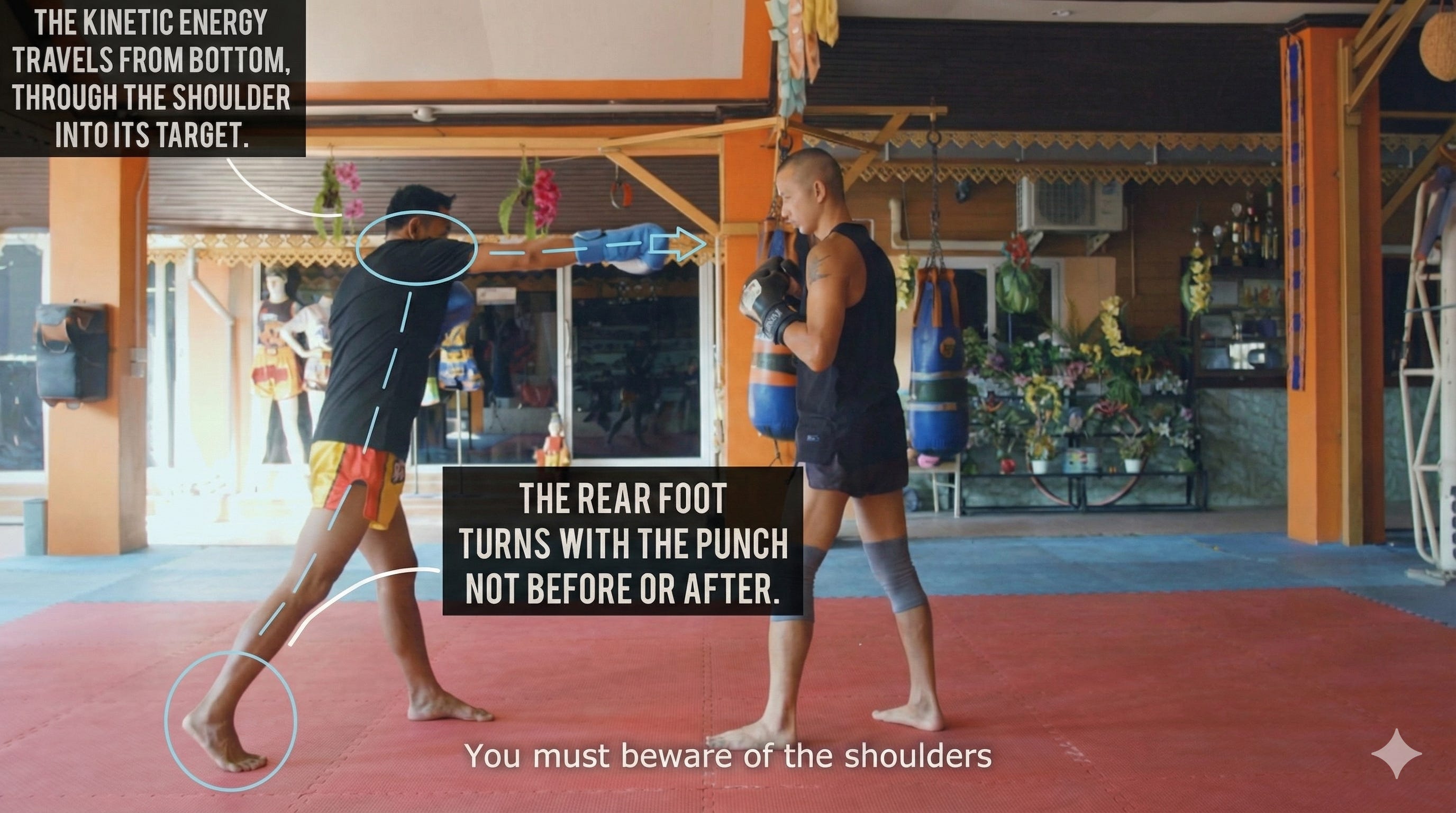
Watch Grandmaster Pipa throw a cross.
His elbow stays glued to his ribs. Not because it looks good—because he understands something fundamental: the shortest distance between two points is a straight line.
Every inch your fist drifts from that path is time given to your opponent. Time to counter. Time to evade. Time you can’t afford.
This is what separates legendary strikers from everyone else.
They don’t waste motion. They don’t wind up. They don’t push from the shoulder, hoping momentum carries them through.
They strike—and that distinction changes everything.
Your arm is just the delivery mechanism. The power? That comes from somewhere else entirely.
The Kinetic Chain
Watch Pipa’s cross in slow motion. The power doesn’t start in his shoulder.
It starts in his rear foot.
Rear foot pivots → hip rotates → shoulder drives → arm extends.
When done right, this sequence appears instant. Simultaneous. That’s the kinetic chain at the highest level—a cascade of force traveling from the ground beneath your feet to two square inches of knuckles.
Most fighters never get this. They muscle through with their upper body, using only their deltoids, triceps, chest—small muscle groups. Meanwhile, the real engine—legs, hips, core—sits idle.
The difference in power is enormous.
Engage your entire posterior chain and your body becomes a unified force transfer system. Legs generate raw power. Hips multiply it through leverage. Core channels it upward. Shoulder transfers it cleanly. Arm delivers it.
But here’s the critical part Pipa always emphasizes: the transfer must be clean.
Any pause, any mistimed rotation, any break in the chain—the energy scatters. What should arrive as concentrated force at the target dissipates into empty space.
Amateur fighters rotate their hips, pause, then extend their arm. The chain is broken. The timing fractured.
Saenchai, Lerdsila, Somrak—they’ve mastered the timing. Everything fires together. One synchronized explosion.
That’s the difference between pushing and striking.
Push: you’re fighting with 20-30% of your available power.
Strike: you’re fighting with your entire body, from the ground up.
The Final Touch
Watch the very end of Grandmaster Pipa’s cross.
As his arm reaches full extension, his knuckles rotate—subtle, but crucial.
This does two things: adds a whisper of extra reach, and creates a sharp, percussive snap at impact.
That snap? That’s the difference between contact and damage.
Full extension isn’t about looking technical. It’s about controlling distance, dictating range, maintaining the speed advantage from the outside.
You’re not just hitting. You’re controlling the geometry of the fight itself.
Study the details. Master the chain. Control the distance
The Philosophy of Distance
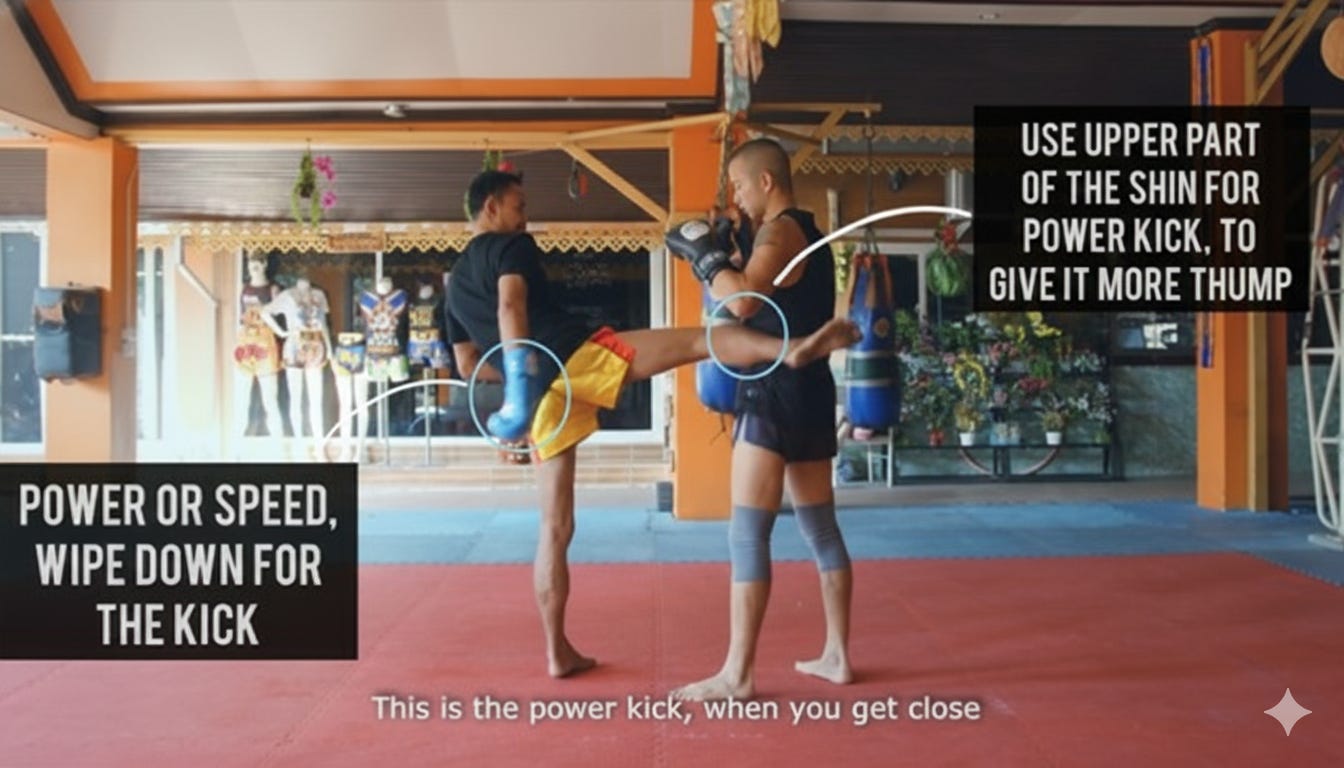
Distance Isn’t Just Space—It’s Strategy
Here’s the unlock most fighters never understand:
Long range = speed.
Short range = power.
Whether you’re punching or kicking, distance rewrites the physics entirely.
Power Through Proximity
Move closer. Strike with your upper shin.
Now leverage works in your favor.
The upper shin sits near your hip joint—creating a rigid lever arm with minimal flex. When impact occurs, force transfers cleanly. Directly. Devastatingly.
No whip. No wasted motion. Just concentrated, bone-shaking power.
This is the kick that breaks guards and buckles knees.
Here’s why it works:
By reducing distance, you eliminate the variables that dissipate force. Everything arrives at once—focused, final.
Hit closer with proper leverage, and the physics align in your favor. The impact point matters. The range dictates the outcome.
The principle is simple. The execution is everything.
Pipa understood this at a level most coaches never reach. Distance isn’t just about where you stand—it’s about which physics equation you’re choosing to use.
Close range? You’re maximizing force transfer through structural rigidity.
The body becomes a hammer, not a whip.
And when technique meets physics at the perfect distance, the result is undeniable.
Speed Through Distance: The Physics of the Long-Range Game
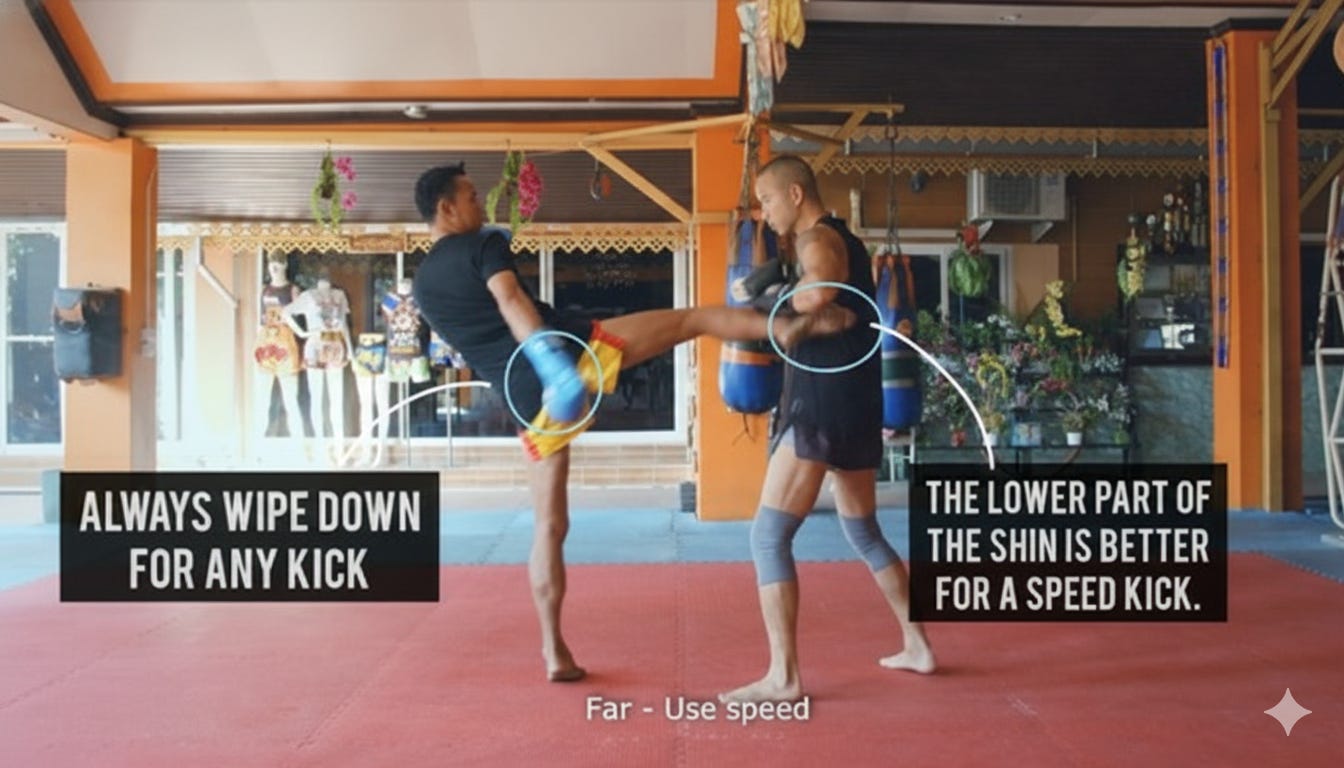
Speed Through Distance
Now watch Pipa at long range.
Notice where his kicks land—lower shin, instep, sometimes the toes. He’s deliberately trading raw power for velocity and reach.
Here’s the physics:
The lower leg sits farther from your hip’s axis of rotation. To reach the target, it travels a longer arc. That extended path becomes an accelerator—building momentum across the entire rotation.
This is why Grandmaster Pipa call it a “whip” rather than a “club.”
Watch Lerdsila’s teeps at maximum range. His leg extends completely, the foot accelerates through space, impact occurs at the very end of that whipping motion.
Faster. Sharper. Harder to read.
The opponent sees the chamber, but the strike arrives with deceptive speed.
The Deeper Game
Here’s what Grandmaster Pipa understood intuitively:
At long range, your opponent has time. Time to read tells, adjust position, prepare counters.
So speed becomes necessity. You’re giving them distance to react—you must remove the time to do so.
But here’s the paradox:
This same distance grants you control.
Watch Saenchai fight taller opponents. He keeps them at the absolute end of his reach—not because he can’t close distance, but because distance is control.
Just outside their punching range. Well within his kicking range.
Now he dictates everything:
When exchanges happen
What techniques get used
When they’re allowed to close the gap
This is what Pipa meant: A controlled opponent is already defeated—even before the decisive blow lands.
You’re not just winning exchanges. You’re determining whether exchanges happen at all.
Geometric Dominance
Watch Saenchai, Lerdsila, and Somrak’s legendary fights.
Their distance and timing control were so precise that opponents looked hesitant, confused, unable to implement their game plan.
That’s not luck. That’s systematic range control eliminating options before they materialize.
The long teep isn’t just scoring—it’s resetting distance, breaking rhythm, reminding them you own the space between you.
The whipping kick isn’t just fast. It’s a declaration.
This is high-level Thai boxing: understanding that speed at range isn’t about power generation—it’s about control maintenance.
The fight doesn’t happen where your opponent wants it.
It happens where you allow it.
And if they want to change that? They have to solve your speed problem first.
Master the distance. Control the fight.
If you want to learn from the Grandmaster Pipa ↓
Pipa’s GOAT Muay Thai Coaching System - The greatest coach of all time (who produced Saenchai, Lerdsila, and Somrak) reveals his complete training methodology and technical frameworks
Thank You
Most technique instruction tells you what to do. We show you why it works—and what separates world-class striking from everything else.
If you found value in this breakdown of the kinetic chain, distance control, and the physics behind devastating strikes, Legendary Striking offers this level of depth every single week.
We don’t just demonstrate techniques—we deconstruct the biomechanics, the tactical principles, and the systematic intelligence that my grandmaster Pipa developed training champions like Somrak, Saenchai, and Lerdsila.
Subscribe for free to receive weekly technical breakdowns that go beyond surface-level instruction. Paid subscribers unlock exclusive masterclass footage from Grandmaster Pipa, detailed coaching sessions, breakdown videos analyzing legendary fighters, and access to our community where we discuss the deeper technical game.
Until next time—study the details others miss, focus on clean transfers over raw effort, and remember: speed isn’t about trying harder. It’s about understanding the chain.
— Lawrence Kenshin
The principles that Grandmaster Pipa teachers on the kinetic chain, distance control, and devastating strikes aren’t mystical secrets reserved for champions like Saenchai or Somrak. They’re systematic frameworks built on biomechanics, timing refinement, and technical understanding that anyone can develop.
If you want to understand how legends achieve what looks effortless—and apply those principles to your own training—I’ve worked directly with my grandmaster and the greatest strikers in history to preserve their methods in systematic courses:
Learn from the legends themselves:
Pipa’s GOAT Muay Thai Coaching System - The greatest coach of all time (who produced Saenchai, Lerdsila, and Somrak) reveals his complete training methodology and technical frameworks
Lerdsila’s Untouchable Striking System - The most elusive fighter in history breaks down the genius-level fight IQ behind his impossible defense and effortless dominance
Saenchai’s Fighting Giants Master Course - The best Muay Thai fighter of the last three decades teaches his complete system for defeating bigger, stronger opponents
Rodtang’s Ruthless Knockout System - Learn the fearless aggression and championship dominance of this era’s most popular Muay Thai fighter
Sagat’s Unstoppable Knockout System - The greatest knockout artist in Muay Thai history and Street Fighter icon shares his legendary techniques
Samkor’s Unstoppable Left Kick System - The most feared left kicker of all time teaches his legendary southpaw system
Learn the systems developed from these principles:
These are the same methods that helped produce world champions and achieve a 90%+ win rate:
Legendary Striking Curriculum - The most organized tactical striking course ever created, systematizing the principles you see in these breakdowns
Legendary Fundamentals Premium - Build your striking progression with sport science-backed fundamentals that work for beginners and advanced athletes
Legendary Striking Premium Bundle - Both premium courses combined with exclusive sport science bonuses and limited 1-on-1 coaching access—enrollment capped to maintain coaching quality
To read more about the journey preserving these legends’ knowledge and the feedback from champions in our space, check out lawrencekenshin.com/testimonials